
Urgent course correc,on needed for a planet in crisis
CBD Alliance SBI 7 Closing statement
When Development Overlaps with Biodiversity Matters
Azka Syamila, Action for Ecology and People Emancipation - Mainstreaming biodiversity within and across sectors is the key to the implementation of KMGBF, particularly in planning and managing development that drives land-use change, such as the development of extractive industry. Target 1 calls on Parties to ensure that all areas are under participatory, integrated and biodiversity inclusive spatial planning. Key Biodiversity Areas (KBAs) provide spatial datasets that help governments and stakeholders to identify and map where conservation priorities lie. However, one of the main challenges in implementing this target is when extractive industry’s concessions have been allocated without consideration of biodiversity matters, resulting in overlaps between extractive industry’s concessions and KBAs.
On [“actors other than national governments”]
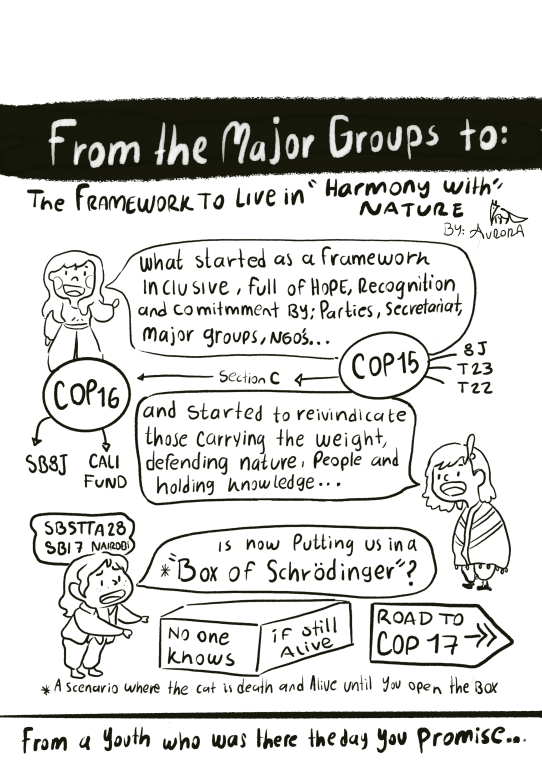
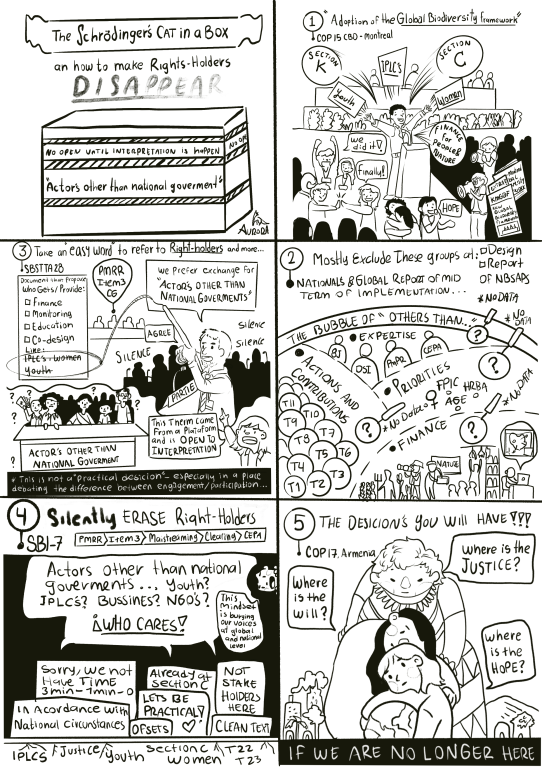
Xilonem Clarke, Forest Peoples Programme & Josefa Tauli, Global Youth Biodiversity Network - When you speak to everyone, you speak to no one. After its humble origins in a decision on PMRR on communicating voluntary commitments, the term “actors other than national Governments” has started making its way into SBSTTA and SBI decisions on Item 3. It has slowly proliferated across several SBI draft decisions, a seductive alternative to difficult paragraphs on long days. Unfortunately, it creates more problems that it solves. We are already foreseeing decisions that are confusing, vague, imprecise, invisibilizing for marginalized groups, and that speak to everyone and no one in particular. Our policies risk becoming invitations without an addressee, a shout into the void, a shapeless blob.
Doing less harm to nature is also GBF implementation
Ermelinda Mahmutaj, Environmental Centre for Development, Educa8on and Networking (EDEN), Albania - The Vjosë-Narta test: when governments choose more harm. Despite activities spurred by the adoption of the KMGBF in 2022, the world still isn’t on track to reach the 2030 targets. More needs to be done: more efforts to update the NBSAPs, to implement them, more collaboration and more resources. But “doing less” can be just as important: less damage to nature, less pollution, less harmful subsidies.
Biodiversity finance cannot come from the sale of “permits to destroy”
Mirna Ines Fernández Pradel, Third World Network - A lot of the discussions in SBI7 have revolved around the various biodiversity finance mechanisms that are proposed with the aim of closing the biodiversity finance gap. While it is true that biodiversity conservation and restoradon are still underfunded, especially in countries in the Global South, global efforts to raise the finance is needed to achieve the global biodiversity targets cannot overlook the impacts that these finance mechanisms have on ecosystems and human rights.